
Stripe dbt Package
This dbt package transforms data from Fivetran's Stripe connector into analytics-ready tables.
Resources
- Number of materialized models¹: 61
- Connector documentation
- dbt package documentation
- dbt Core™ supported versions
>=1.3.0, <3.0.0- Decisionlog
What does this dbt package do?
This package enables you to better understand your Stripe transactions, enhance balance transaction entries with useful fields, and generate metrics tables for account activity analysis. It creates enriched models with metrics focused on transaction analysis, customer insights, and revenue tracking.
Output schema
Final output tables are generated in the following target schema:
<your_database>.<connector/schema_name>_stripe
Final output tables
By default, this package materializes the following final tables:
| Table | Description |
|---|---|
| stripe__balance_transactions | Represents each change to your Stripe balance with transaction context. Example Analytics Questions:
|
| stripe__invoice_details | Contains invoice records with associated charge, customer, and subscription data. Example Analytics Questions:
|
| stripe__invoice_line_item_details | Includes line items with charge, customer, subscription, and pricing details. Example Analytics Questions:
|
| stripe__daily_overview | Summarizes daily and rolling Stripe transaction totals by type. Example Analytics Questions:
|
| stripe__subscription_details | Contains subscription records with customer and payment metrics. Example Analytics Questions:
|
| stripe__customer_overview | Shows customer-level metrics with transaction details and associations. Example Analytics Questions:
|
| stripe__activity_itemized_2 | Lists balance transactions with invoice, fee, refund, and customer data. Example Analytics Questions:
|
| stripe__balance_change_from_activity_itemized_3 | Reconciles Stripe balance changes like a detailed bank statement. Example Analytics Questions:
|
| stripe__ending_balance_reconciliation_itemized_4 | Matches bank payouts with unsettled Stripe transactions. Example Analytics Questions:
|
| stripe__payout_itemized_3 | Details expected and actual payout amounts and statuses. Example Analytics Questions:
|
| stripe__line_item_enhanced | Provides unified reporting across billing platforms on product, customer, and revenue metrics. See the Fivetran Billing Model Streamlit App for more details. Example Analytics Questions:
|
| stripe__subscription_item_mrr_report | Shows both contracted and billed MRR (monthly recurring revenue) with discounts applied at the subscription item level. Tracks MRR changes over time, classifying each month as new, expansion, contraction, churned, reactivation, or unchanged. Relies on invoice_line_item for historical quantity, so it requires stripe__using_invoices (enabled by default) and does not build when that variable is disabled.Example Analytics Questions:
|
¹ Each Quickstart transformation job run materializes these models if all components of this data model are enabled. This count includes all staging, intermediate, and final models materialized as view, table, or incremental.
Visualizations
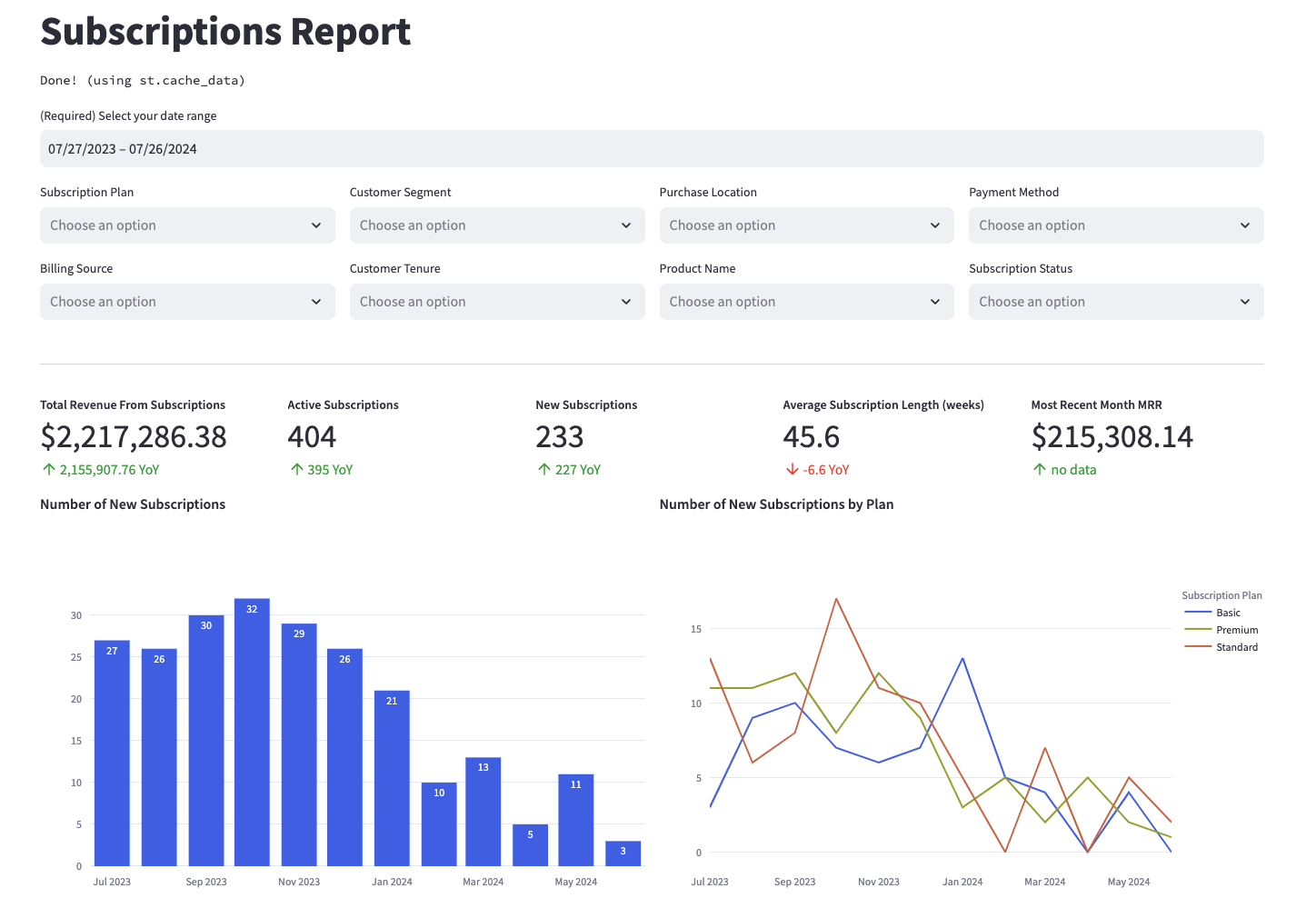
Many of the above reports are now configurable for visualization via Streamlit. Check out some sample reports here.
Prerequisites
To use this dbt package, you must have the following:
- At least one Fivetran Stripe connection syncing data into your destination.
- A BigQuery, Snowflake, Redshift, Databricks, or PostgreSQL destination.
How do I use the dbt package?
You can either add this dbt package in the Fivetran dashboard or import it into your dbt project:
- To add the package in the Fivetran dashboard, follow our Quickstart guide.
- To add the package to your dbt project, follow the setup instructions in the dbt package's README file to use this package.
How is this package maintained and can I contribute?
Package Maintenance
The Fivetran team maintaining this package only maintains the latest version of the package. We highly recommend you stay consistent with the latest version of the package and refer to the CHANGELOG and release notes for more information on changes across versions.
Contributions
A small team of analytics engineers at Fivetran develops these dbt packages. However, the packages are made better by community contributions.
We highly encourage and welcome contributions to this package. Learn how to contribute to a package in dbt's Contributing to an external dbt package article.